Well with a new Star Wars film in the offing this Xmas, I am at this juncture reminded of the following quote from the 1977 original classic:
Darth Vadar: 'I’ve been waiting for you, Obi-Wan. We meet again, at last. The circle is now complete. When I left you, I was but the learner; now I am the master'.
So with this in mind the occasional Moulton staff member will still contribute to the blog, but it will also harness the talents of a new generation - students across several years of our FdSc Countryside & Wildlife Management and BSc Land Management programmes! The first post of which is by Sam (see below).
Nice!
Tuesday, 22 November 2016
Saturday, 19 November 2016
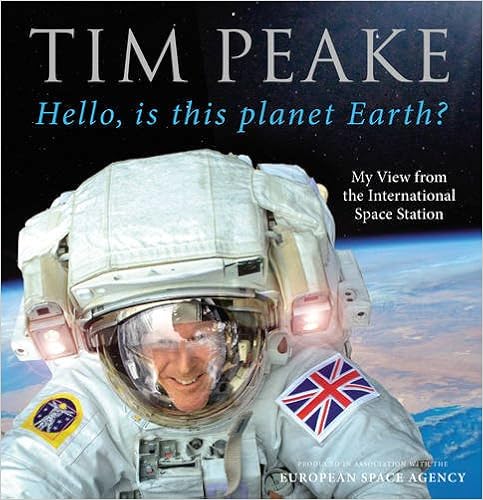
Hello, is this planet Earth?

From a distance you realise the beauty of this planet and what it gives us, along with the varying terrain and the glorious oceans. As Tim Peake himself writes in the book;
"It's impossible to look down on Earth from space and not be mesmerised by the fragile beauty of our planet.'
I may have been 400km up, but I have never felt closer to Earth than when I was on board the International Space Station.
I'm delighted to share with you this collection of photographs with some of my thoughts from my mission. Although I briefly left the santuary of our planet, I rediscovered the wonder of the place we call home".
I urge you to go out and buy this book, whether you are involved in a course looking at countryside management, are considering a new course or are having doubts about a career choice. Because the beauty of this planet really makes you want to try as hard as you can to preserve it, manage it, and make it a better place for every organism on it. For those of you inspired to try and make a difference, remember Moulton College has an open day on Thursday 1st December, between 17:00 and 19:00, and you can register on the day for a course that inspires you.
Tim Peake's proceeds for this book go to The Princes Trust.
Wednesday, 14 September 2016
Nature Appears to be in a State
Well that's all a bit depressing, but with the publication of the annual State of Nature Report 2016 it seems British wildlife is still in trouble. It seems the authors are quick to point the finger at the custodians of the British countryside - our farmers, but the real reasons for reported declines may well be far more complex.
Sir David Attenborough launches the RSPB authored report today and using modern Red List criteria, which identify species of the highest conservation concern, 8,000 species were assessed. Of these, 15% are reported as being 'extinct' or 'threatened with extinction' from Great Britain.Turtle doves and hedgehogs are reported to be in serious decline, but it's not all bad news. Indeed some species including otters and red kites are on the rise.
Our courses provide a platform to train conservationists in methods to best halt these declines - why not get in touch today?!
Sir David Attenborough launches the RSPB authored report today and using modern Red List criteria, which identify species of the highest conservation concern, 8,000 species were assessed. Of these, 15% are reported as being 'extinct' or 'threatened with extinction' from Great Britain.Turtle doves and hedgehogs are reported to be in serious decline, but it's not all bad news. Indeed some species including otters and red kites are on the rise.
Our courses provide a platform to train conservationists in methods to best halt these declines - why not get in touch today?!
| Water vole print found by a Moulton student along the River Ise last year |
Monday, 5 September 2016
Moulton College Research features in prestigious British Wildlife Photography Awards 2016!
After the publication of a rather striking image last month in
the National Geographic taken by photographer Nick Upton from our
ongoing research project on the conservation of British mammals, the College
was pleased to hear that more of Nick’s pictures have resulted in him claiming
top prize in the hard fought ‘best documentary series’ category.
You can view
the gallery of images here and you will note that Moulton's own PhD researcher Emily Howard-Williams and her faithful
sidekick ‘Tui the dog’ play a prominent role!
Nick will receive his award – won over thousands of other
entries - at the famous Mall Gallery in central London tonight where all of the
images can be viewed by the public from September 6th – 10th.
The work is already proving popular with the public and press alike, with the
likes of The Guardian featuring it today. Great news all round!
|
|
Wednesday, 10 August 2016
Monday, 8 August 2016
Moulton Research reaches Global Audience in the National Geographic!
In the Spielberg classic film 'Jaws', there is an infamous scene where fisheries expert Hooper (played by Richard Dreyfuss) confronts Mayor Vaughan (played by Murray Hamilton) about his decision to keep the beaches of fictional Amity Island open, despite the presence of the notorious great white shark. The following dialogue ensues:
Hooper: Mr. Vaughn, what we are dealing with here is a perfect engine, an eating machine. It's really a miracle of evolution. All this machine does is swim and eat and make little sharks, and that's all. Now, why don't you take a long, close look at this sign.
[refers to the graffitied billboard]
Hooper: Those proportions are correct.
Mayor Vaughn: Love to prove that, wouldn't ya? Get your name into the National Geographic.
This rather obscure link leads me to report that if you pop down to your local newsagents today and flick through the latest August edition
of the National Geographic magazine, you might find a great white but you will also find a striking image
linked to one of our ongoing research projects here at the College! The image
was taken by a professional photographer who visited the College last summer to
document our ongoing conservation work with the photogenic but incredibly
elusive harvest mouse. We have been investigating the ecological habits of this
most charismatic of creatures as a means of prescribing pro-active conservation
measures to ensure its survival in our green and pleasant countryside.
With a global
circulation of around 7 million, this truly puts Moulton’s research on a
global stage! To find out more about this and other research activities we
undertake, why not check out: https://twitter.com/MoultonResearch
Friday, 24 June 2016
A Euro Haze Descends to create 'A Perfect Storm'.......
Well, after an unprecedented night including the resignation of our Prime Minister, it seems a slender minority have pushed the BREXIT movement so we are now faced with leaving the EU. But where does this leave farmers who claim subsidies from Europe or indeed the future for British wildlife?
On the farming side, the alternative plans for subsidy support to replace basic payment and rural development schemes are hazy. The average farm support subsidy across the EU is around €12,200, and whilst this may not seem a great deal - it is often the difference between profit and loss for small sized agri-businesses. A few months ago the Yorkshire Agricultural Society gazed Nostradamus-like into the future and concluded rather gloomily that BREXIT would not be beneficial for UK farmers (link to report here). Today the National Farmers Union have re-iterated the fact that British farmers face a period of uncertainty (link to statement here).
Looking forwards, Defra will have its work cut out to try and create new national policies to provide synergy between the demand (and cost) for public goods and the need for higher farm income. Their subsequent steering will have to integrate food security, sustainable management for natural resources and climate and balanced territorial development – something that the CAP was always criticised for. With BREXIT creating additional fiscal instability, the idiom of 'public money for public goods' will no doubt rear its head more emphatically than ever before.
On the farming side, the alternative plans for subsidy support to replace basic payment and rural development schemes are hazy. The average farm support subsidy across the EU is around €12,200, and whilst this may not seem a great deal - it is often the difference between profit and loss for small sized agri-businesses. A few months ago the Yorkshire Agricultural Society gazed Nostradamus-like into the future and concluded rather gloomily that BREXIT would not be beneficial for UK farmers (link to report here). Today the National Farmers Union have re-iterated the fact that British farmers face a period of uncertainty (link to statement here).
Looking forwards, Defra will have its work cut out to try and create new national policies to provide synergy between the demand (and cost) for public goods and the need for higher farm income. Their subsequent steering will have to integrate food security, sustainable management for natural resources and climate and balanced territorial development – something that the CAP was always criticised for. With BREXIT creating additional fiscal instability, the idiom of 'public money for public goods' will no doubt rear its head more emphatically than ever before.
![]() |
| The confirmed exit from the EU may not provide a Halcyon paradise as some commentators suggest |
For our native wildlife, there is no doubt that European Directives and Regulations have strengthened protection - either for individual species or for where they are found. Again, it is not clear either how or to what extent these policies would be replaced, but one can't help thinking that the loss of the European Protected Species as sanctioned through the Habitats Directive (1994) might be missed most of all. Worryingly, the Chartered Institute of Ecology & Environmental Management (CIEEM), the Worldwide Fund for Nature (WWF) and the Royal Society for the Protection of Birds (RSPB) all concurred with a recent report by Institute for European Environmental Policy (IEEP) that concluded the UK environment would be 'vulnerable' after exit (link to paper).
| A sleepy hazel dormouse - one of the native species that until today received extra legislative protection through EU Directives. Pic: J Littlemore. |
Whilst the debate has clearly been an emotive issue where political manoeuvring has been a clear impetus and the media frenzy concerning immigration seems to have swayed public opinion, the future of farming and of conservation is clearly in the balance. It will now require a steady hand at the tiller to steer a way through this particular perfect storm......
The views expressed by the author of this article are theirs alone.
Subscribe to:
Posts (Atom)