Just a quick one this - Andy Beal from Absolute Fisheries was in yesterday to demonstrate the art of electro-fishing. This approach involves stunning fish with a electric current so that stock assessments and health checks can be made - all without harming the fish of course!
Image courtesy of Sophie from BSc Land Management! More pix are on our Twitter feed, check it out (including Rob vs. crayfish!): click me
Wednesday, 8 February 2017
Friday, 27 January 2017
Starting September 2016 - Part-time course
,
![]() |
| Find out more at: http://www.moulton.ac.uk/our-courses/part-time To view the prospectus: Moulton Part-Time 2016 Prospectus To contact us, please call us on 01604 491131, or email us on at enquires@moulton.ac.uk, we would love to hear from you. |
Tractor Driving
Tractor Driving 27.01.2017
During today's Tractor Driving session, learners got to grip with the College's Case 105c tractor and Case LRA85 front loader.
Students practised their accuracy of loading by loading into a tipper trailer. Another student would then re-position the tractor and trailer and tip it ready to be re-loaded.
Students really enjoyed the session and learned a useful skill at the same time.
Dakota fire pits
Dakota fire pits!
First year Extended diploma students made a Dakota fire pit
this week.
Dakota fire holes are another way of lighting a fire outside
with many advantages over a traditional camp fire. Although fairly labour
intensive Dakota fire pits burn at a higher temperature with much less fuel
than a traditional campfire making them more efficient. You can use them for
cooking and boiling water with minimal fuel and water will boil much faster
than with a conventional camp fire.
You need to plan carefully, you need to be able to dig
easily, in free draining soil that isn’t too wet, or sandy soil which will collapse
or rocky conditions in which digging will be impossible.
Dakota
fire pits work by drawing air through the tunnel and into the fire chamber; you
should build your pit so that the wind is blowing through the tunnel.
Wednesday, 25 January 2017
Big Garden Birdwatch 28th-30th January

The Big Garden Birdwatch, organised by the RSPB (Royal Society for Protection of Birds) are organising the annual Big Garden Birdwatch for 2017. They have been arranging these since 1979 when it was just done by junior members, and in 2016 more than 519,000 people all over the UK counted 8,262,662 birds!
The 2017 count is the first one to go into three days, from January 28th (Saturday) to Monday January 30th.
It is not too late to be a member of this vital count that tells the RSPB about the decline (or hopefully the increase) in the number of birds on these shores, and monitor their trends.
It is not too late to register and download the pack. Visit https://ww2.rspb.org.uk/get-involved/activities/birdwatch/ to get involved. You even get £5 off your next RSPB shop order and free delivery if you register before 30th January.
Tuesday, 24 January 2017
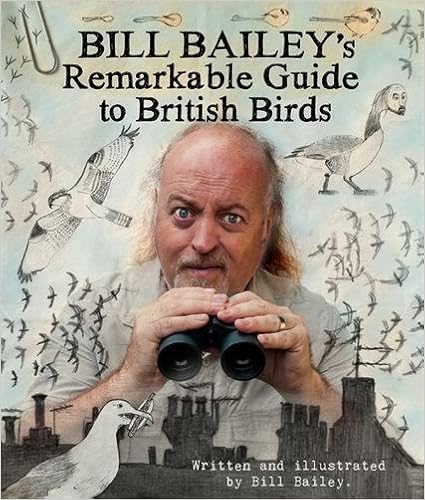
Bill Bailey's Remarkable Guide to British Birds

Book reviews on this blog are akin London buses, there are none and then there are two (although you would not normally wait two months for a bus!).
Bill Bailey is a famous comedian, and one of Britain's most famous "twitchers". His book on the most commonly seen, and some of the less seen birds of the UK (his favourite 51) is one that he has written and illustrated himself in a personal and comedic manner. He has made all notes, illustrations and cartoons himself, and includes interesting facts about all species he features, such as, "It is said that gulls are the spirit of old fishermen. Old fisherman who liked nicking chips", and on voles, a staple diet of the kestrel, "voles are the all-purpose snack, the buttered toast of British wildlife" (best read with his West Country accent in mind).
He is passionate about the subject, and his passion shows through in all the sections of the book, not just the more exotic species (such as the red-throated diver) but even the common species such as the house sparrow, and as with everything he does, his passion is infectious.
However, Bill does not tell you that the scientific name of the house sparrow is Passer domesticus. He also does not explain that the UK bird population is in rapid decline, and have been since 1980. This is specifically poignant with regards to farmland birds, such as the grey partridge. He also does not explain how this can be fixed (not that you would expect him to in a light-hearted book such as this).
These are things that can be learned through study. Education is intrinsic in helping to remedy the decline of UK bird populations, and in turn to create a more sustainable planet for the species to thrive on. To be part of the solution, please feel free to come along to the Moulton College Open Day on Saturday February 4th between 08:00 and 12:00. Alternatively, you can email us at enquires@moulton.ac.uk, or telephone us on 01604 491131. We look forward to seeing you!
Friday, 13 January 2017
Countryside Management Action!
So here are some links to some activities our HE students have been up to - take a look! First up are some fine hedgelaying skills at Rutland Water.......
Secondly, we have some fisheries work at Corby Boating Lakes with Andy Beal!
Subscribe to:
Posts (Atom)