

Monday, 7 August 2017

Thursday, 13 April 2017
'Taking Aim' to Support Country Sports and Landscape Conservation!
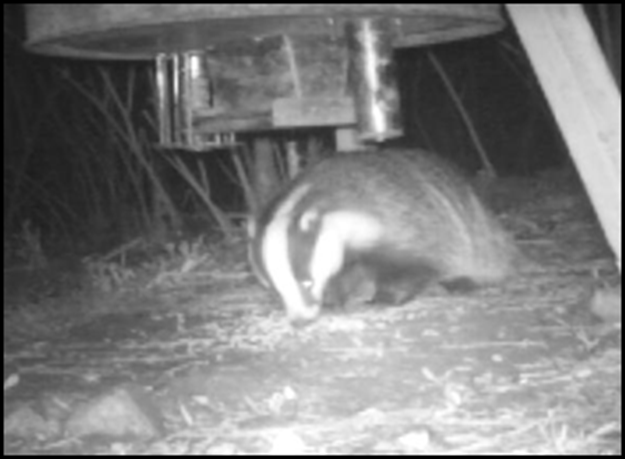
There is no doubt country sports polarise opinion and whilst it is not the job of this blogger to persuade you either way, like so many things in life perhaps the solution lies in making an informed opinion based on published research. For example, ecological research undertaken by our undergraduates and presented at the British Ecological Society Winter Meeting at the University of Birmingham showed that supplementary feeding from pheasant hoppers attracted a great number of birds on the 'Birds of Conservation Concern' list - particularly on small farm shoots. Even badgers were attracted to the hoppers, as the camera trap 'still' testifies below.

Indeed, it seems that there might be other benefits associated with managing the countryside for game species, and some lie alongside the health and well-being and 'natural capital' agendas. Moreover, a future research project is tabled to provide an unbiased and balanced view of the social and environmental impacts linked to driven game shoots - you can read a hot off the press blog post on the Game & Wildlife Conservation Trust (GWCT) blog page here.

Check back to the blog from time to time to see news updates on this and other research we are taking aim at currently!
Indeed, it seems that there might be other benefits associated with managing the countryside for game species, and some lie alongside the health and well-being and 'natural capital' agendas. Moreover, a future research project is tabled to provide an unbiased and balanced view of the social and environmental impacts linked to driven game shoots - you can read a hot off the press blog post on the Game & Wildlife Conservation Trust (GWCT) blog page here.

Check back to the blog from time to time to see news updates on this and other research we are taking aim at currently!
Tuesday, 14 March 2017
Moulton Agriculture features on BBC TV!
Our students and staff are a busy bunch, with lots of exciting things happening currently. Top of the tree is probably the fine work our livestock lecturer Ed and his students did by featuring in the BBC series ‘The Farmers Country Showdown’ which was broadcast this month!
Featuring a piece called the College Challenge, students took part in a stock judging competition at The Smithfield Festival last November. The filming followed the student’s journey from the preparation at College through to the main event! Check it out here!

Featuring a piece called the College Challenge, students took part in a stock judging competition at The Smithfield Festival last November. The filming followed the student’s journey from the preparation at College through to the main event! Check it out here!

Monday, 27 February 2017
Eye of Toad and Tongue of Newton the Newt!
Whilst out and about on the estate this week, Level 3 BTEC Countryside Management students Jacob and Jack stumbled across a European protected species - a Great Crested Newt which they named 'Newton'! This juvenile amphibian was found underneath a log, indicating that breeding ponds were nearby. A new record for this part of the farm - nice work fellas!
 |
| Jacob (left) and Jack (right) - take a bow! |
 |
| Newton the newt! |
Monday, 13 February 2017
Where does our recycling go? - Part 1
 |
| PMK Recycling Ltd. Picking Line (© PMK Recycling Ltd. 2016) |
Do you ever wonder where your recycling goes after you leave it on the kerbside in the bin for the council to take away?
I did, so a trip to the local recycling plant was required. My local one does not actually recycle the goods, but divides them into their separate groups, such as PET plastics, glass, steel, aluminium, and the one that really surprised me was concrete, which was smashed up into small pieces that could be used elsewhere, such as being the aggregate for new concrete. The smashed concrete was outside. along with a large amount of glass bottles straight out of bottle banks which were to be processed.
Inside the first section of the large shed were two hoppers being fed on conveyor belts. Inside the hoppers are trommels with 20mm and 50mm holes to filter out the smallest items. Anything that falls through these holes is whisked away on one conveyor belt, and all the items too large to fall through are taken away on another belt.
The items which fell through the holes are sent into another hopper, which has a large vibrating plate inside. This causes the paper, metals and plastics to be filtered out and sent to one pile, and the glass to be sent to a separate pile.
The conveyor belt with the larger items headed up towards the picking line, however before it reached the line, a magnet removes all the steel. After this, the employees on the picking line remove everything that isn't paper, so all aluminium cans for example. These items are dropped into various bins, which, when full, are put through a baler and stored as a bale ready for the next part of their journey. The paper wasn't picked because it fell into the end bin and was then baled the same way.
I was advised that some of the plastics, such as green drinks bottles, have to be separated from the clear, as they cannot be dealt with the same way, and how the different types of plastics go to different processing plant, depending on the material they are made of. So, for example, an empty packet of washing liquid would be separated from drinks bottles.
It's an impressive process to see how an empty can of drink can go from the bin full of recycling to being separated and ready to be sent away for re-processing in pretty quick time.
Of course all this helps preserve the natural raw materials that, without the companies such the one I visited doing this vital work, would be mined or made, losing more natural resources that are so important to so many aspects of the planet, and creating greenhouse gases that we cannot really manage.
A special thanks goes to Damian at PMK Recycling for his guidance around the site and his explanations of everything I didn't understand (which was a lot!).
Wednesday, 8 February 2017
Electro-fishing for Beginners!
Just a quick one this - Andy Beal from Absolute Fisheries was in yesterday to demonstrate the art of electro-fishing. This approach involves stunning fish with a electric current so that stock assessments and health checks can be made - all without harming the fish of course!

Image courtesy of Sophie from BSc Land Management! More pix are on our Twitter feed, check it out (including Rob vs. crayfish!): click me

Image courtesy of Sophie from BSc Land Management! More pix are on our Twitter feed, check it out (including Rob vs. crayfish!): click me
Friday, 27 January 2017
Starting September 2016 - Part-time course
,
 |
| Find out more at: http://www.moulton.ac.uk/our-courses/part-time To view the prospectus: Moulton Part-Time 2016 Prospectus To contact us, please call us on 01604 491131, or email us on at enquires@moulton.ac.uk, we would love to hear from you. |
Tractor Driving
Tractor Driving 27.01.2017

During today's Tractor Driving session, learners got to grip with the College's Case 105c tractor and Case LRA85 front loader.
Students practised their accuracy of loading by loading into a tipper trailer. Another student would then re-position the tractor and trailer and tip it ready to be re-loaded.

Students really enjoyed the session and learned a useful skill at the same time.
Dakota fire pits
Dakota fire pits!
First year Extended diploma students made a Dakota fire pit
this week.
Dakota fire holes are another way of lighting a fire outside
with many advantages over a traditional camp fire. Although fairly labour
intensive Dakota fire pits burn at a higher temperature with much less fuel
than a traditional campfire making them more efficient. You can use them for
cooking and boiling water with minimal fuel and water will boil much faster
than with a conventional camp fire.

You need to plan carefully, you need to be able to dig
easily, in free draining soil that isn’t too wet, or sandy soil which will collapse
or rocky conditions in which digging will be impossible.

Dakota
fire pits work by drawing air through the tunnel and into the fire chamber; you
should build your pit so that the wind is blowing through the tunnel.
Wednesday, 25 January 2017
Big Garden Birdwatch 28th-30th January
The Big Garden Birdwatch, organised by the RSPB (Royal Society for Protection of Birds) are organising the annual Big Garden Birdwatch for 2017. They have been arranging these since 1979 when it was just done by junior members, and in 2016 more than 519,000 people all over the UK counted 8,262,662 birds!
The 2017 count is the first one to go into three days, from January 28th (Saturday) to Monday January 30th.
It is not too late to be a member of this vital count that tells the RSPB about the decline (or hopefully the increase) in the number of birds on these shores, and monitor their trends.
It is not too late to register and download the pack. Visit https://ww2.rspb.org.uk/get-involved/activities/birdwatch/ to get involved. You even get £5 off your next RSPB shop order and free delivery if you register before 30th January.
Tuesday, 24 January 2017
Bill Bailey's Remarkable Guide to British Birds
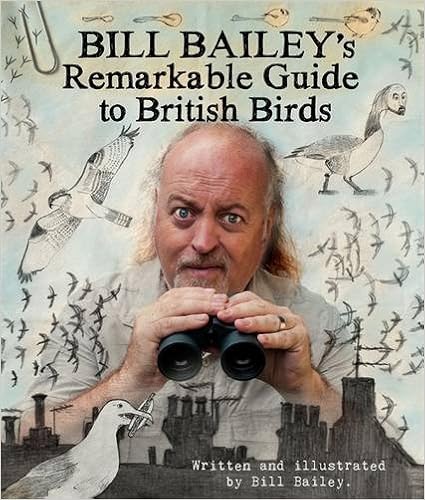
Book reviews on this blog are akin London buses, there are none and then there are two (although you would not normally wait two months for a bus!).
Bill Bailey is a famous comedian, and one of Britain's most famous "twitchers". His book on the most commonly seen, and some of the less seen birds of the UK (his favourite 51) is one that he has written and illustrated himself in a personal and comedic manner. He has made all notes, illustrations and cartoons himself, and includes interesting facts about all species he features, such as, "It is said that gulls are the spirit of old fishermen. Old fisherman who liked nicking chips", and on voles, a staple diet of the kestrel, "voles are the all-purpose snack, the buttered toast of British wildlife" (best read with his West Country accent in mind).
He is passionate about the subject, and his passion shows through in all the sections of the book, not just the more exotic species (such as the red-throated diver) but even the common species such as the house sparrow, and as with everything he does, his passion is infectious.
However, Bill does not tell you that the scientific name of the house sparrow is Passer domesticus. He also does not explain that the UK bird population is in rapid decline, and have been since 1980. This is specifically poignant with regards to farmland birds, such as the grey partridge. He also does not explain how this can be fixed (not that you would expect him to in a light-hearted book such as this).
These are things that can be learned through study. Education is intrinsic in helping to remedy the decline of UK bird populations, and in turn to create a more sustainable planet for the species to thrive on. To be part of the solution, please feel free to come along to the Moulton College Open Day on Saturday February 4th between 08:00 and 12:00. Alternatively, you can email us at enquires@moulton.ac.uk, or telephone us on 01604 491131. We look forward to seeing you!
Friday, 13 January 2017
Countryside Management Action!
So here are some links to some activities our HE students have been up to - take a look! First up are some fine hedgelaying skills at Rutland Water.......
Secondly, we have some fisheries work at Corby Boating Lakes with Andy Beal!
Secondly, we have some fisheries work at Corby Boating Lakes with Andy Beal!
Tuesday, 22 November 2016
Countryside Bloggers: A New Hope!
Well with a new Star Wars film in the offing this Xmas, I am at this juncture reminded of the following quote from the 1977 original classic:
Darth Vadar: 'I’ve been waiting for you, Obi-Wan. We meet again, at last. The circle is now complete. When I left you, I was but the learner; now I am the master'.

So with this in mind the occasional Moulton staff member will still contribute to the blog, but it will also harness the talents of a new generation - students across several years of our FdSc Countryside & Wildlife Management and BSc Land Management programmes! The first post of which is by Sam (see below).
Nice!
Darth Vadar: 'I’ve been waiting for you, Obi-Wan. We meet again, at last. The circle is now complete. When I left you, I was but the learner; now I am the master'.

So with this in mind the occasional Moulton staff member will still contribute to the blog, but it will also harness the talents of a new generation - students across several years of our FdSc Countryside & Wildlife Management and BSc Land Management programmes! The first post of which is by Sam (see below).
Nice!
Saturday, 19 November 2016
Hello, is this planet Earth?

From a distance you realise the beauty of this planet and what it gives us, along with the varying terrain and the glorious oceans. As Tim Peake himself writes in the book;
"It's impossible to look down on Earth from space and not be mesmerised by the fragile beauty of our planet.'
I may have been 400km up, but I have never felt closer to Earth than when I was on board the International Space Station.
I'm delighted to share with you this collection of photographs with some of my thoughts from my mission. Although I briefly left the santuary of our planet, I rediscovered the wonder of the place we call home".
I urge you to go out and buy this book, whether you are involved in a course looking at countryside management, are considering a new course or are having doubts about a career choice. Because the beauty of this planet really makes you want to try as hard as you can to preserve it, manage it, and make it a better place for every organism on it. For those of you inspired to try and make a difference, remember Moulton College has an open day on Thursday 1st December, between 17:00 and 19:00, and you can register on the day for a course that inspires you.
Tim Peake's proceeds for this book go to The Princes Trust.
Wednesday, 14 September 2016
Nature Appears to be in a State
Well that's all a bit depressing, but with the publication of the annual State of Nature Report 2016 it seems British wildlife is still in trouble. It seems the authors are quick to point the finger at the custodians of the British countryside - our farmers, but the real reasons for reported declines may well be far more complex.
Sir David Attenborough launches the RSPB authored report today and using modern Red List criteria, which identify species of the highest conservation concern, 8,000 species were assessed. Of these, 15% are reported as being 'extinct' or 'threatened with extinction' from Great Britain.Turtle doves and hedgehogs are reported to be in serious decline, but it's not all bad news. Indeed some species including otters and red kites are on the rise.
Our courses provide a platform to train conservationists in methods to best halt these declines - why not get in touch today?!
Sir David Attenborough launches the RSPB authored report today and using modern Red List criteria, which identify species of the highest conservation concern, 8,000 species were assessed. Of these, 15% are reported as being 'extinct' or 'threatened with extinction' from Great Britain.Turtle doves and hedgehogs are reported to be in serious decline, but it's not all bad news. Indeed some species including otters and red kites are on the rise.
Our courses provide a platform to train conservationists in methods to best halt these declines - why not get in touch today?!
 |
| Water vole print found by a Moulton student along the River Ise last year |
Monday, 5 September 2016
Moulton College Research features in prestigious British Wildlife Photography Awards 2016!
After the publication of a rather striking image last month in
the National Geographic taken by photographer Nick Upton from our
ongoing research project on the conservation of British mammals, the College
was pleased to hear that more of Nick’s pictures have resulted in him claiming
top prize in the hard fought ‘best documentary series’ category.
You can view
the gallery of images here and you will note that Moulton's own PhD researcher Emily Howard-Williams and her faithful
sidekick ‘Tui the dog’ play a prominent role!
Nick will receive his award – won over thousands of other
entries - at the famous Mall Gallery in central London tonight where all of the
images can be viewed by the public from September 6th – 10th.
The work is already proving popular with the public and press alike, with the
likes of The Guardian featuring it today. Great news all round!
|
|

Wednesday, 10 August 2016


Monday, 8 August 2016
Moulton Research reaches Global Audience in the National Geographic!
In the Spielberg classic film 'Jaws', there is an infamous scene where fisheries expert Hooper (played by Richard Dreyfuss) confronts Mayor Vaughan (played by Murray Hamilton) about his decision to keep the beaches of fictional Amity Island open, despite the presence of the notorious great white shark. The following dialogue ensues:
Hooper: Mr. Vaughn, what we are dealing with here is a perfect engine, an eating machine. It's really a miracle of evolution. All this machine does is swim and eat and make little sharks, and that's all. Now, why don't you take a long, close look at this sign.
[refers to the graffitied billboard]
Hooper: Those proportions are correct.
Mayor Vaughn: Love to prove that, wouldn't ya? Get your name into the National Geographic.

This rather obscure link leads me to report that if you pop down to your local newsagents today and flick through the latest August edition
of the National Geographic magazine, you might find a great white but you will also find a striking image
linked to one of our ongoing research projects here at the College! The image
was taken by a professional photographer who visited the College last summer to
document our ongoing conservation work with the photogenic but incredibly
elusive harvest mouse. We have been investigating the ecological habits of this
most charismatic of creatures as a means of prescribing pro-active conservation
measures to ensure its survival in our green and pleasant countryside.

With a global
circulation of around 7 million, this truly puts Moulton’s research on a
global stage! To find out more about this and other research activities we
undertake, why not check out: https://twitter.com/MoultonResearch
Friday, 24 June 2016
A Euro Haze Descends to create 'A Perfect Storm'.......
Well, after an unprecedented night including the resignation of our Prime Minister, it seems a slender minority have pushed the BREXIT movement so we are now faced with leaving the EU. But where does this leave farmers who claim subsidies from Europe or indeed the future for British wildlife?
On the farming side, the alternative plans for subsidy support to replace basic payment and rural development schemes are hazy. The average farm support subsidy across the EU is around €12,200, and whilst this may not seem a great deal - it is often the difference between profit and loss for small sized agri-businesses. A few months ago the Yorkshire Agricultural Society gazed Nostradamus-like into the future and concluded rather gloomily that BREXIT would not be beneficial for UK farmers (link to report here). Today the National Farmers Union have re-iterated the fact that British farmers face a period of uncertainty (link to statement here).
Looking forwards, Defra will have its work cut out to try and create new national policies to provide synergy between the demand (and cost) for public goods and the need for higher farm income. Their subsequent steering will have to integrate food security, sustainable management for natural resources and climate and balanced territorial development – something that the CAP was always criticised for. With BREXIT creating additional fiscal instability, the idiom of 'public money for public goods' will no doubt rear its head more emphatically than ever before.
On the farming side, the alternative plans for subsidy support to replace basic payment and rural development schemes are hazy. The average farm support subsidy across the EU is around €12,200, and whilst this may not seem a great deal - it is often the difference between profit and loss for small sized agri-businesses. A few months ago the Yorkshire Agricultural Society gazed Nostradamus-like into the future and concluded rather gloomily that BREXIT would not be beneficial for UK farmers (link to report here). Today the National Farmers Union have re-iterated the fact that British farmers face a period of uncertainty (link to statement here).
Looking forwards, Defra will have its work cut out to try and create new national policies to provide synergy between the demand (and cost) for public goods and the need for higher farm income. Their subsequent steering will have to integrate food security, sustainable management for natural resources and climate and balanced territorial development – something that the CAP was always criticised for. With BREXIT creating additional fiscal instability, the idiom of 'public money for public goods' will no doubt rear its head more emphatically than ever before.
 |
| The confirmed exit from the EU may not provide a Halcyon paradise as some commentators suggest |
For our native wildlife, there is no doubt that European Directives and Regulations have strengthened protection - either for individual species or for where they are found. Again, it is not clear either how or to what extent these policies would be replaced, but one can't help thinking that the loss of the European Protected Species as sanctioned through the Habitats Directive (1994) might be missed most of all. Worryingly, the Chartered Institute of Ecology & Environmental Management (CIEEM), the Worldwide Fund for Nature (WWF) and the Royal Society for the Protection of Birds (RSPB) all concurred with a recent report by Institute for European Environmental Policy (IEEP) that concluded the UK environment would be 'vulnerable' after exit (link to paper).
 |
| A sleepy hazel dormouse - one of the native species that until today received extra legislative protection through EU Directives. Pic: J Littlemore. |
Whilst the debate has clearly been an emotive issue where political manoeuvring has been a clear impetus and the media frenzy concerning immigration seems to have swayed public opinion, the future of farming and of conservation is clearly in the balance. It will now require a steady hand at the tiller to steer a way through this particular perfect storm......
The views expressed by the author of this article are theirs alone.
Friday, 10 June 2016
Conserving our Green and Pleasant Land!
Georgina Wallis is busy. Not only has she just managed to complete her Foundation Degree in Agriculture with great aplomb, but she has accomplished this feat whilst working as the Catchment Sensitive Farming Officer for the River Nene Regional Park (RNRP). Her role is key in supporting local farmers to balance sustainable intensification of their farms with wider environmental considerations such as managing water pollution, protecting biodiversity and even combating climate change.
Georgina explains….. ‘In my role at the RNRP, I have enjoyed helping farmers in implementing new countryside stewardship schemes on their land so they can seek to balance production with caring for the environment’. She adds ‘This year I was able to carry out an industry project alongside my course where I interviewed a wide cross section of farmers. Thankfully there was a strong agreement across all farm types and sizes that agri-environmental schemes should be part of an integrated farm approach, justifying my professional role’.
The integration of environmental friendly farming practices is not new, but with recent changes to the Common Agricultural Policy persuading land owners to take on the new schemes is an ongoing battle. The value of infield options including pollen and nectar mixes is much publicised; indeed turning just a small amount of commercial farmland into habitat for pollinators actually increases some yields, despite the loss of land in production (Nowakowski & Pywell, 2016).
 |
| Georgina (left) on a farm visit |
With an additional challenge of representing the England women’s ‘tug-o’-war’ team, it seems Georgina will continue to be in demand!
Her story is similar to many of our other Graduates, who benefit from the close links we have with industry throughout our courses. For more information on our agriculture and countryside management courses, why not get in touch today?
Subscribe to:
Posts (Atom)